Learn more about the technology behind OpenTrade.
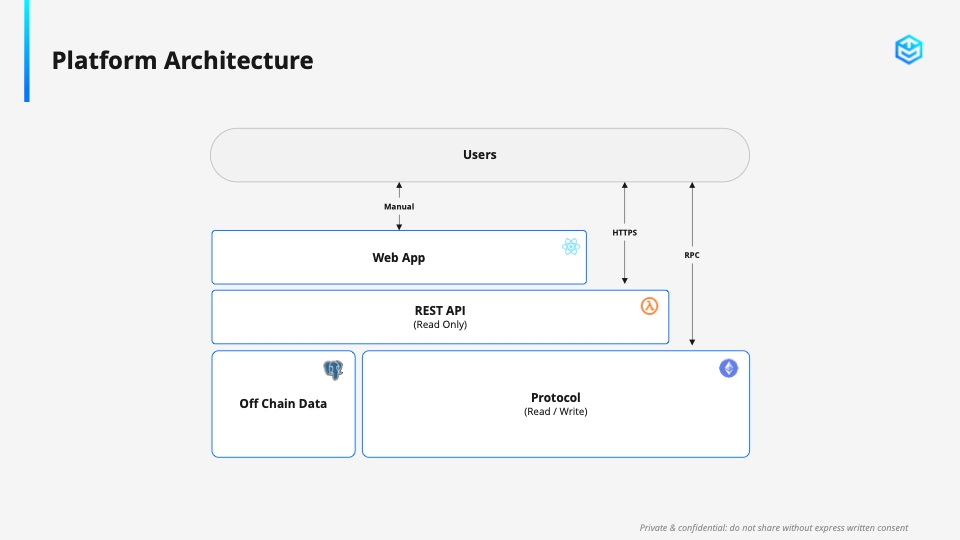
The OpenTrade Platform consists of a web application and API running on a blockchain protocol that supports a wide variety of stablecoin lending and yield products.
Products
OpenTrade's initial products built on the protocol are focused on stablecoin yield.
Our Treasury Management Product & Yield Product, which enables Web3 and Web2 fintechs to power their own embedded yield products for their customers and enables institutional investors to better manage their treasury cash.
The Platform has been designed to be extensible and composable across other Web2 and Web3 applications. We're currently working on integrations with several other credit markets, market makers, and exchanges to provide more utility, liquidity, and possibilities to OpenTrade users.
While we provide a user interface with our web application, users and partners can develop their own interfaces on the protocol and integrate with their existing systems.
Partners, like exchanges, custodians, and wallets can leverage OpenTrade's platform and legal framework to provide institutional grade yield products to their customers.
If you're interested in partnering with us or building on OpenTrade, please send us a message at [email protected] and a member of our team will be in touch.
OpenTrade's blockchain protocol is a fork of Perimeter, an open-source stablecoin lending protocol developed by , a division of Circle Internet Financial LLC ("Circle").
The blockchain protocol is a series of smart-contracts deployed on Ethereum and Avalanche that are based largely on ERC-4626 and ERC-20 standards.
Learn more about the blockchain protocol here:
The web application is a cloud-based web application accessed through the browser. It provides an intuitive user interface for interacting with our stablecoin yield products, but others are free to develop their own interfaces on the protocol and API.
Learn more about the web application here:
A list of the digital assets we currently support lending activity with through the OpenTrade platform.
Currently Supported
Learn more about the OpenTrade Web Application
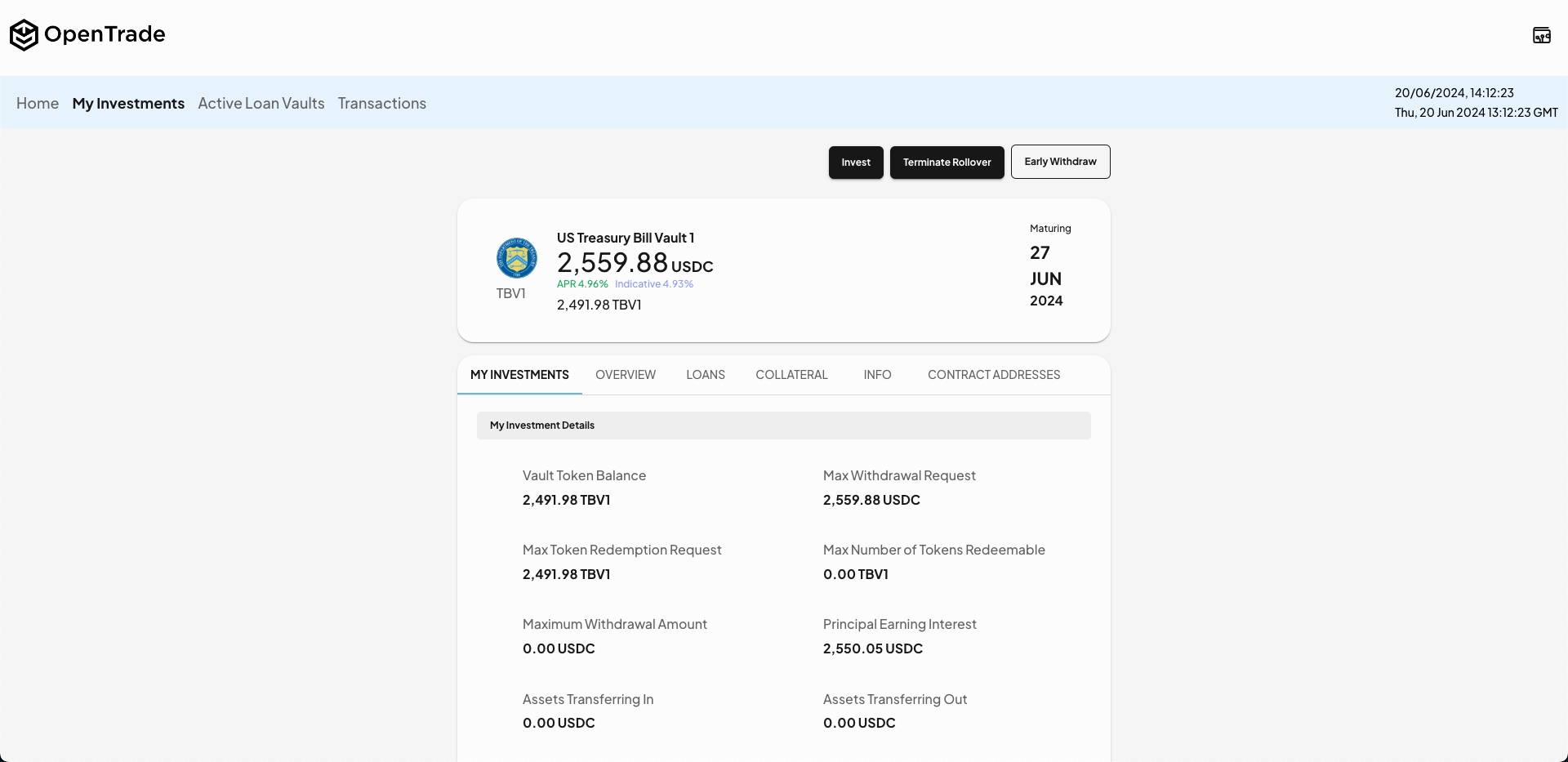
The OpenTrade web application is a cloud-hosted web application that serves primarily as an interface to OpenTrade's Blockchain Protocol.
The web application allows users to interact directly with the protocol by connecting their white-listed wallets and displaying relevant information, data, and workflow to assist users in interacting with the protocol.
Click here to visit the OpenTrade Web App
Learn more about the blockchain protocol underpinning OpenTrade products.
OpenTrade's blockchain protocol is based on Perimeter, an open-source blockchain protocol developed by , a division of , to support USDC lending markets and applications. The protocol is largely built on composable, open-source standards, including , .
The OpenTrade protocol is developed and maintained by Open Trade Technology Ltd. It has been modified extensively to support a nearly limitless variety of RWA and DeFi backed stablecoin yield vaults.
The protocol can support a wide variety of on-chain structured credit and lending products, including but not limited to:
Yield products involving both real world assets ("RWA") and digital assets
Collateralised and uncollateralized loans
Single-sided and multi-sided credit markets
Primary and secondary credit markets
Fixed rate and variable rate products
Fixed term and open-term products
We intend to continue to extend and enhance the protocol to support an increasingly wide variety of use cases across both RWAs and digital assets.
The core of the protocol is based on ERC-4626, an open-source standard for yield bearing token vaults. It is an extension of ERC-20 token standard. It has been designed to optimise and unify the technical parameters of yield-bearing vaults.
It provides a standard smart-contract interface for tokenised yield-bearing vaults. A yield-bearing vault is a smart contract that allows users to deposit different ERC-20 tokens into a pool of tokens in exchange for vTokens (vault tokens). Vault tokens give their holders a claim on underlying asset tokens held by the vault, plus any profits the pool has earned, minus any losses, defaults, and fees.
Vault tokens can be converted to asset tokens, and asset tokens can be converted to vault tokens, with the exchange occurring at an exchange rate determined by the smart-contract.
The standard is fully described in EIP-4626 as published and maintained by Ethereum.org.
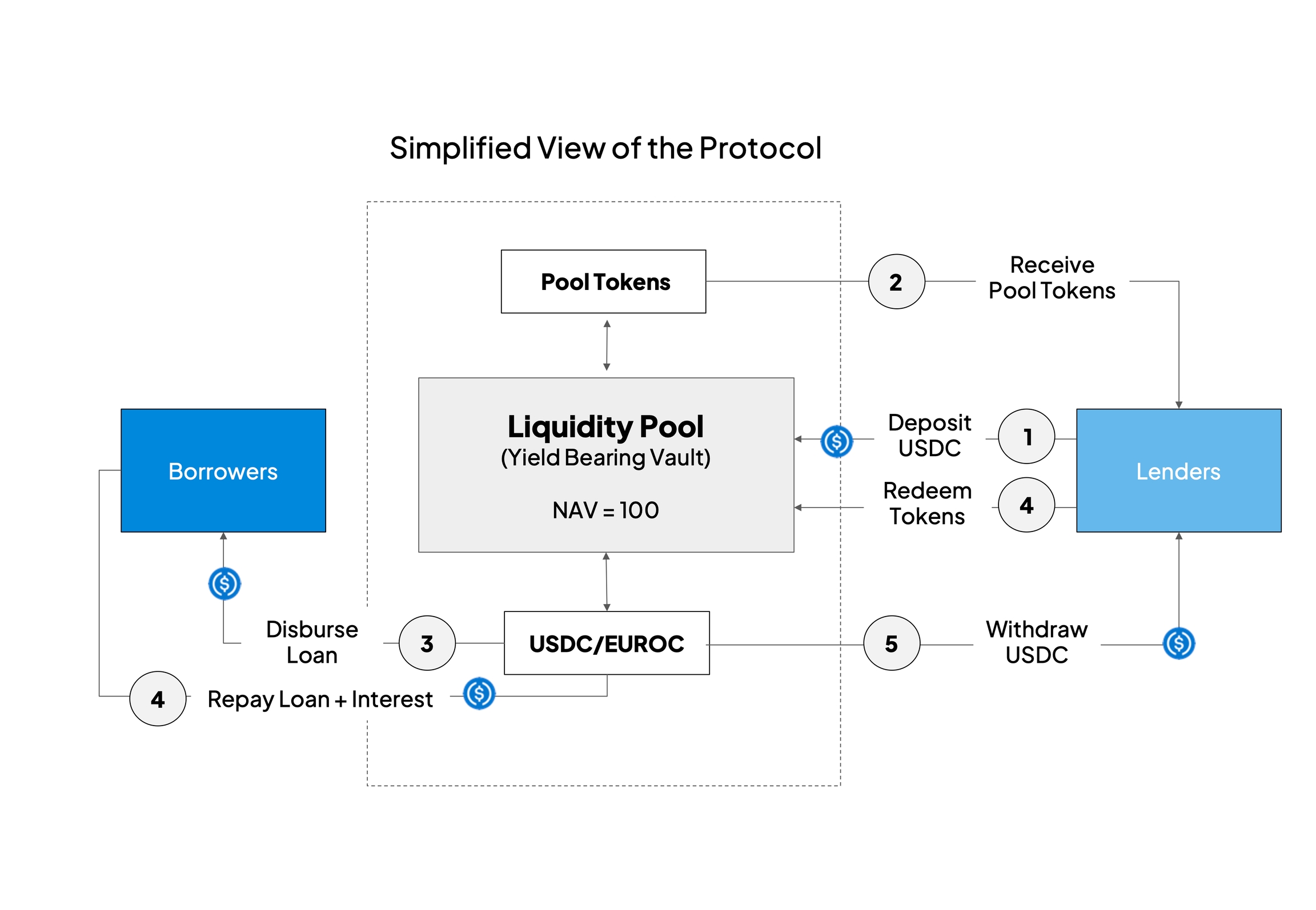
When lenders deposit ERC-20 stablecoin tokens (USDC, EURC, USDT, etc) into the vault, they are issued ERC-20 tokens called vault tokens in return. This is done at the current exchange rate.
Each vault token represents a unit of ownership in the vault and its underlying assets, which are principally collateralised and uncollateralized USDC loans and USDC.
Loans are structured and disbursed to borrowers from these vaults. As loans are issued, loan repayments are made, and interest is accrued, the exchange of each vault increases, meaning the value of each vault token increases by a corresponding amount. If defaults occur, the exchange of each vault decreases, meaning each vault token decreases by a corresponding amount.
When a lender withdraws from the vault, they exchange their vault tokens for the underlying asset token (USDC) at the current exchange rate.
Protocol Operator: The protocol operator is responsible for deploying, maintaining, and upgrading the protocol. Open Trade Technology Ltd. serves as the protocol operator.
Vault Admin: Specialised entities that create and manage vaults, source borrowers, and manage liquidity in the protocol. Open Trade Technology Ltd serves as the vault admin for all OpenTrade products.
Borrowers: Entities that receive stablecoin loans from liquidity pools and repay those loans plus interest. Borrowers on the OpenTrade platform are bankruptcy remote SPVs overseen by FCA regulated Five Sigma. Currently the only approved Borrower is OpenTrade SPC.
Lenders: Lenders provide liquidity by depositing tokenised cash (USDC and EUROC) to earn interest. Lenders are KYC’d Web3 institutions, businesses, and HNWI. For more information on who is eligible to become a Lender on OpenTrade, please see Eligibility Requirements.
A list of the Digital Wallets we currently support for use with the OpenTrade Platform.
You should only have one active browser wallet when interacting with the OpenTrade web app. Having more than one type of wallet extension active in your browser simultaneously will cause them to work incorrectly. Please either deactivate (or toggle off) the additional extensions until you only have one active or use multiple browsers or browser profiles to access them separately.
Currently Supported
MetaMask
Fireblocks via WalletConnect
MetaMask Institutional
Coinbase Wallet
ForeDeFi
WalletConnect compatible wallets
A list of the Blockchain Networks we currently support.
Currently Supported
Ethereum
Avalanche C-Chain
Coming Soon
Plume
Base
We're an institutional lending platform for tokenized financial assets
Sign Up Today!: If you're interesting in onboarding to OpenTrade, please visit our website and click Request Access and one of our team members will contact you to get the onboarding process started. Please note we are currently experiencing a high volume of onboarding requests and are prioritising those already on the waitlist. Apologies in advance for any delay.
Learn more about the onboarding process and eligibility requirements.
OpenTrade is an institutional grade platform for stablecoin lending and yield products. Our offering combines a technology platform, legal framework, and network of regulated financial institutions that enable safe, compliant, and scalable stablecoin lending and yields products for the next generation of financial services & markets.
Use Cases
Enabling 3rd parties like exchanges, neobanks, digital wallets, custodians, and other fintechs to offers institutional grade yield products to their users
Enabling investors to build diversified portfolios of tokenized fixed income products for themselves and their customers
Providing builders, token issuers, and credit markets with new, composable forms of digital collateral to power the next generation of financial markets